
A real AI sex doll factory has to do two jobs that rarely sit in the same building: make a believable body and support a connected electronic product. Plenty of suppliers can cast silicone. Far fewer can control firmware versions, replace a failed sensor, keep an app working after a phone update, and tell you which production batch a voice module came from. That second job is where most sourcing decisions are won or lost.
This walkthrough explains what happens inside a factory that actually builds AI companion dolls, where the electronics enter the production line, what to inspect on a tour, and which questions expose an assembler that is only buying finished modules from someone else.
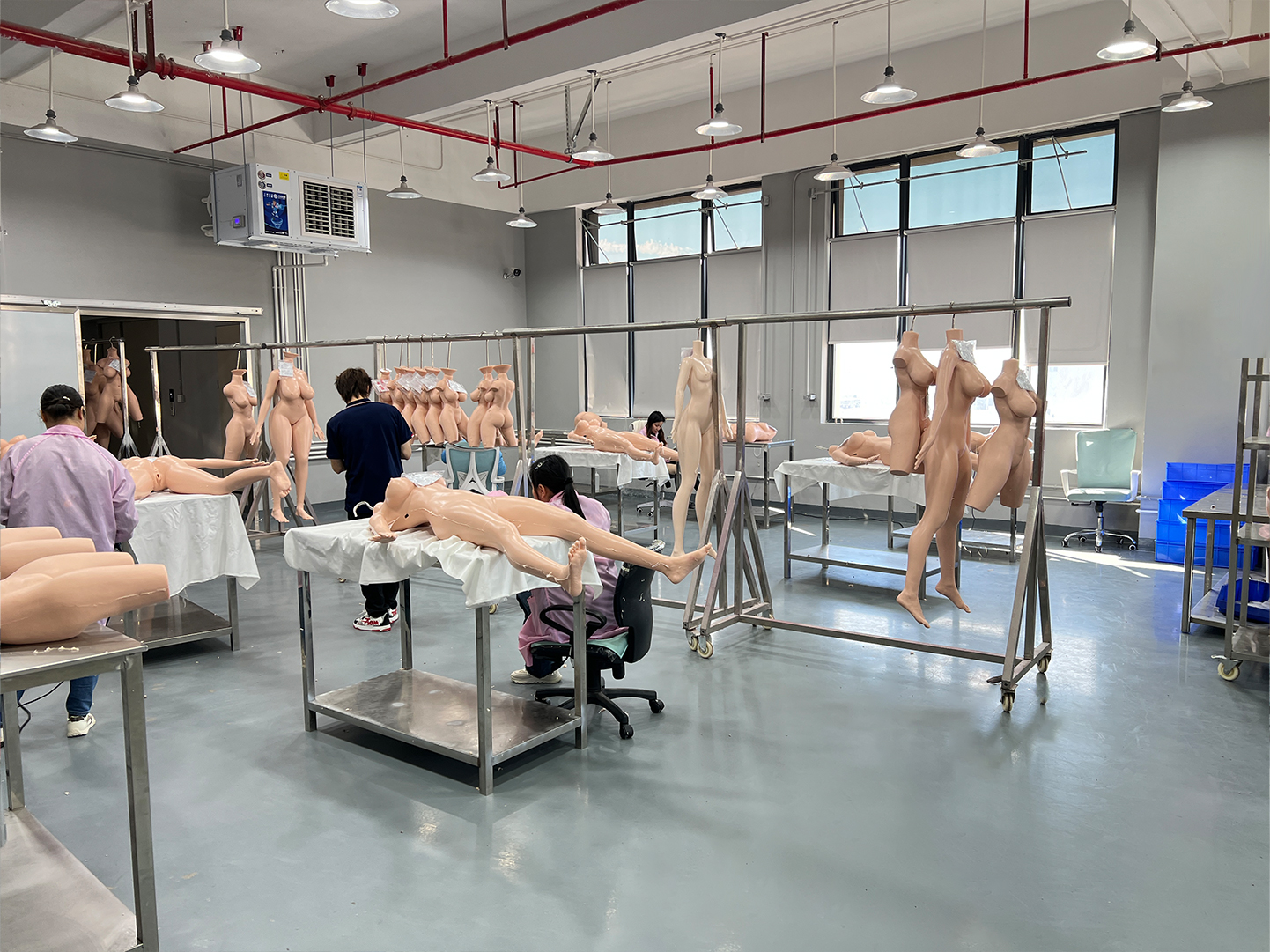
Assembly and finishing are only part of the process. The electronics integration and test benches decide whether the product survives month three.
Two factories in one building
A conventional doll factory is organized around molds, material batches, casting, trimming, painting and packing. An AI doll factory adds a second operation: electronics assembly, firmware loading, app pairing, burn-in testing and after-sales module replacement.
Those two operations have different rhythms. Silicone needs cure time and hand work. Electronics need controlled stock, ESD protection, stable firmware and test records. When a supplier tries to run both without separate owners, the result is predictable: beautiful bodies with undocumented electronics, or a good prototype that cannot be repeated in mass production.
When you audit a factory, ask who owns each side. If the answer is the same person for mold making, firmware and export sales, the operation is probably too small to support a connected product at scale. That is not automatically a disqualifier for a small pilot. It is a warning for a 500-unit program.
The production route, stage by stage
The doll itself follows a well-established path. The AI-specific work starts later than most buyers expect, and it continues after the body is finished.
| Stage | What happens | Where AI enters |
|---|---|---|
| 1. Concept and 3D design | Proportions, face, body, joint range and packaging are defined. | Space for speaker, microphone, board, battery and charging port is reserved in the model. |
| 2. Sculpt and prototype | The master face and body are hand-finished and photographed for approval. | Head cavity and neck routing are checked with a dummy electronics pack. |
| 3. Mold and tooling | Production molds are cut or cast from the approved master. | Mold inserts may need changes for sensor pockets or cable channels. |
| 4. Silicone or TPE casting | Material is mixed, degassed, pigmented and cast. | Wall thickness around speakers and ports must be controlled. |
| 5. Skeleton and joint assembly | Metal skeleton, joints and internal structure are installed and load-tested. | Wiring must avoid pinch points at the neck, shoulders, hips and knees. |
| 6. Hair, eyes and makeup | Hair, eyes, brows, lips and nails are finished by hand. | Eye and neck mechanisms, if used, are aligned before finishing. |
| 7. Function and AI integration | Heating, vibration, voice and AI modules are wired and calibrated. | Firmware is loaded, paired, tested and recorded against the serial number. |
| 8. Final QC and packing | Appearance, function, accessories and packaging are checked. | Battery state, account reset and app pairing are verified before sealing. |
The important detail is stage seven. If electronics are installed after the body is closed, or if the test is limited to "it powers on", the factory is assembling rather than integrating. Integration means the module was designed for the cavity, the cables have strain relief, the microphone has a clean acoustic path, and the unit can be serviced without destroying the body.
What to look for on a factory tour
A video tour is useful, but only if it shows the areas that matter. A showroom with finished dolls tells you almost nothing about repeatability. Ask to see:
- Mold and tooling area. Who cuts the molds, how are they maintained, and where are customer-owned molds stored?
- Casting and curing rooms. Batch records, pigment matching, temperature and humidity control.
- Assembly benches. Whether electronics are installed in a separate clean area or on the same bench as pigment and talc.
- ESD protection. Wrist straps, grounded mats and component storage. Static damage often appears as an intermittent fault weeks later.
- Burn-in racks. Units running audio, heating and charging simultaneously, with a log per serial number.
- Firmware station. A computer that loads and verifies the correct firmware version, not a phone handed around the line.
- Traceability records. A serial number that links to the body batch, electronics batch, test operator and firmware release.
- Spare parts and RMA area. Replacement speakers, boards, sensors, chargers and a documented repair workflow.
If a supplier cannot show you a firmware station or a burn-in rack, ask how they test AI features. "We test every unit" is not an answer unless you can see what the test covers and what gets recorded.
The integration details that decide failure rates
Most AI doll faults are not caused by the AI model. They are caused by the physical integration around it.
Head cavity and acoustic path
A speaker in a sealed silicone head sounds muffled. A microphone behind a thick wall hears the motor and the room, not the user. The factory needs to design a cavity, a port and damping material, then test in the actual body. A module that sounds clear on a bench can sound dull once installed.
Cable routing and strain relief
The neck, shoulders and hips move. Cables that are simply zip-tied to the skeleton will eventually fatigue. Look for service loops, flexible sections, protected connectors and a route that does not cross sharp metal edges. Ask how many open-close cycles the neck assembly is tested for.
Heat and condensation
Electronics generate heat inside an insulating material. Heating elements add more. Without a thermal plan, the board runs hot, the battery ages faster, and moisture can condense after cleaning. Conformal coating, ventilation gaps and a temperature cutoff are not optional on a product that is cleaned and stored in a bathroom or bedroom.
Charging port and battery access
The charging port is one of the first things to fail. It should be reachable, reinforced, and replaceable without cutting the body. The battery should have overcharge and over-discharge protection, a thermal fuse, and test documentation for transport. If the battery is sealed inside with no service path, a two-dollar cell can turn into a full replacement claim.
Serviceability
Ask the factory to open a unit on camera. Can the speaker be replaced? Can the board be swapped without removing the skeleton? Is there a connector map? A product designed for assembly only will be expensive to repair, and the cost comes back to the brand.
Testing that goes beyond power-on
A serious factory tests the electronics as a system, not as separate parts. A useful AI doll test plan includes:
| Test | What it catches | Record to request |
|---|---|---|
| Incoming electronics inspection | Wrong board revision, damaged connectors, counterfeit cells | Batch ID and incoming checklist |
| **** power-on and pairing | Dead units, pairing failures, region mismatch | Serial-level pass/fail |
| Audio test in the target language | Wrong voice pack, muffled speaker, microphone fault | Test audio file and operator sign-off |
| Touch zone test | Dead zones, false triggers, calibration drift | Zone map with results |
| Heating cutoff test | Runaway heater, sensor placement error | Temperature log and cutoff value |
| Battery charge and discharge | Weak cell, short runtime, charging fault | Runtime and charge time |
| 4 to 8 hour burn-in | Intermittent faults, overheating, memory leaks | Burn-in log per unit |
| Carton drop and compression | Shipping damage to head, ports and electronics | Drop test report and carton spec |
| Firmware and app update | Update loops, region locks, account errors | Firmware version and update result |
Sampling alone is not enough for electronics. AQL inspection works for cosmetic defects, but a dead voice module in a sealed doll is a costly return. Test every powered unit, then use AQL for appearance and packing. For a broader inspection framework, see our quality control and AQL guide.
R&D and software support
The factory floor is only half of the capability. Ask who writes the firmware, who maintains the app, and who answers a support ticket six months after launch. A real AI doll factory has, or has contracted, four roles:
- Mechanical engineering: cavities, connectors, strain relief, heating and service access.
- Electronics engineering: board selection, power design, sensor calibration and EMC pre-scan.
- Firmware and app: release management, security patches, language packs and account flows.
- Quality and after-sales: test records, RMA analysis and spare-parts availability.
If the supplier says the app is "provided by our partner", ask for the partner's name, the support term, and what happens if the partnership ends. A cloud feature without a support commitment is a countdown timer on your product.
The OEM/ODM workflow
Custom work is not a single quote and a shipment. A realistic workflow looks like this:
| Step | Typical duration | What you approve |
|---|---|---|
| Brief and specification | 3 to 7 days | Body, material, functions, target market, packaging |
| Quotation and feasibility | 3 to 7 days | Unit cost, tooling, MOQ, lead time, exclusions |
| Prototype | 15 to 30 days | Face, body, color, electronics placement |
| Sample approval | 5 to 10 days | Golden sample, test report, packaging |
| Tooling and production prep | 20 to 40 days | Mold, fixture, firmware, test plan |
| Pilot run | 10 to 20 days | 10 to 50 units, field test results |
| Mass production | 30 to 45 days | Final QC and shipping documents |
These ranges shift with mold complexity, electronics lead time and the approval speed on your side. Treat any quote that promises a custom AI doll in two weeks with suspicion. Either the body is an existing mold and the electronics are off-the-shelf, or the schedule is optimistic.
MOQ and what can be customized
Low-MOQ sample orders are normal for body customization. A factory that owns its molds can produce one sample with a custom face, skin tone, hair and eyes. Production MOQ is a separate discussion and depends on packaging, electronics batch size and material minimums.
What can usually change: face sculpt, body proportions, skin tone, areola and lip color, hair, eyes, nails, skeleton type, heating zones, voice language, app branding and packaging. What should not be improvised: battery safety, charger certification, RF module approval, heating cutoff and data handling. Those are system-level decisions, not cosmetic options.
For MOQ planning, see our private label MOQ guide. For the commercial structure, see OEM, ODM and private label explained.
Certifications and documents
A factory should be able to provide documents for the product you are importing, not just for the raw material. Depending on the market, you may need a CE or UKCA declaration, RoHS and REACH statements, EMC and RF test reports for wireless modules, battery transport documents, safety test reports and a material safety data sheet.
Check the scope. A certificate for a silicone sample does not certify a finished doll with a heater and a radio module. A CE mark on a power adapter does not cover the doll. Ask for the report that names the model, the tested configuration and the standards applied. The importer is usually responsible for the final product's compliance, so the factory's documents are evidence, not a transfer of responsibility.
Twelve audit questions
- Who owns the molds, the firmware and the app account?
- Can you show a unit being opened and serviced?
- Which board revision is in the current BOM, and how are changes controlled?
- What is the firmware update policy after shipment?
- How do you test voice, touch and heating on every unit?
- What burn-in time do you run, and what data is recorded?
- Which languages and accents have been tested in the actual body?
- What is the warranty split between body, skeleton and electronics?
- Which spare modules are stocked, and what is their lead time?
- Can you provide EMC, RF, battery and material reports for this configuration?
- Who handles data deletion when a unit is returned?
- Will you host a live video call from the test bench during my production run?
Where CoolMate fits
CoolMate has been manufacturing companion dolls since 2015. Our Shenzhen facility covers 8,000 m2 with 12 production lines, in-house design, mold making, silicone and TPE casting, finishing, AI module integration and export packing. We run function and aging benches for heating, vibration, voice and AI modules, and we record test results against the order number.
We are a factory, not a retail store. Our work is OEM, ODM, private label and wholesale for brands, distributors and retailers in more than 50 countries. Sample orders start at one piece. If you need a supplier who can show you the line, open a unit, and explain what happens after the sale, book a live factory tour and bring your hardest questions.
Start with our factory page, review the OEM/ODM process, or contact our export team with your model, market and target volume.
Frequently asked questions
What makes a factory an AI sex doll factory rather than a doll factory?
It has a separate electronics integration and test operation: ESD-controlled assembly, firmware loading, burn-in, serial-level test records and a spare-parts path for sensors, boards, speakers and batteries. Without those, it is a doll factory buying modules.
Can I visit the factory?
Yes, serious factories welcome scheduled visits. If travel is not possible, ask for a live video tour that includes the mold shop, casting floor, electronics bench, burn-in rack and packing area, not only the showroom.
How long does a custom AI doll take?
Plan on several weeks for prototype and sample approval, plus tooling and production time. A simple change to an existing mold is faster than a new sculpt with custom electronics. Confirm each stage in writing.
What is the minimum order?
Sample orders can start at one piece. Production MOQ depends on the model, packaging and electronics batch. Ask for both numbers before you plan a launch.
Does the factory support the app after launch?
That should be defined in the contract. Ask for the support period, update frequency, end-of-life policy and what happens to cloud features if the service is discontinued.
About this guide
Prepared by the CoolMate Silicone Doll Factory team based on OEM/ODM production, AI module integration and export QC work in Shenzhen. Factory figures refer to our current facility and can be verified on a live tour. Product configurations, certifications and lead times are confirmed per order.
Last reviewed: 28 October 2026 by the CoolMate production team. This guide is commercial and technical information, not legal or regulatory advice.